
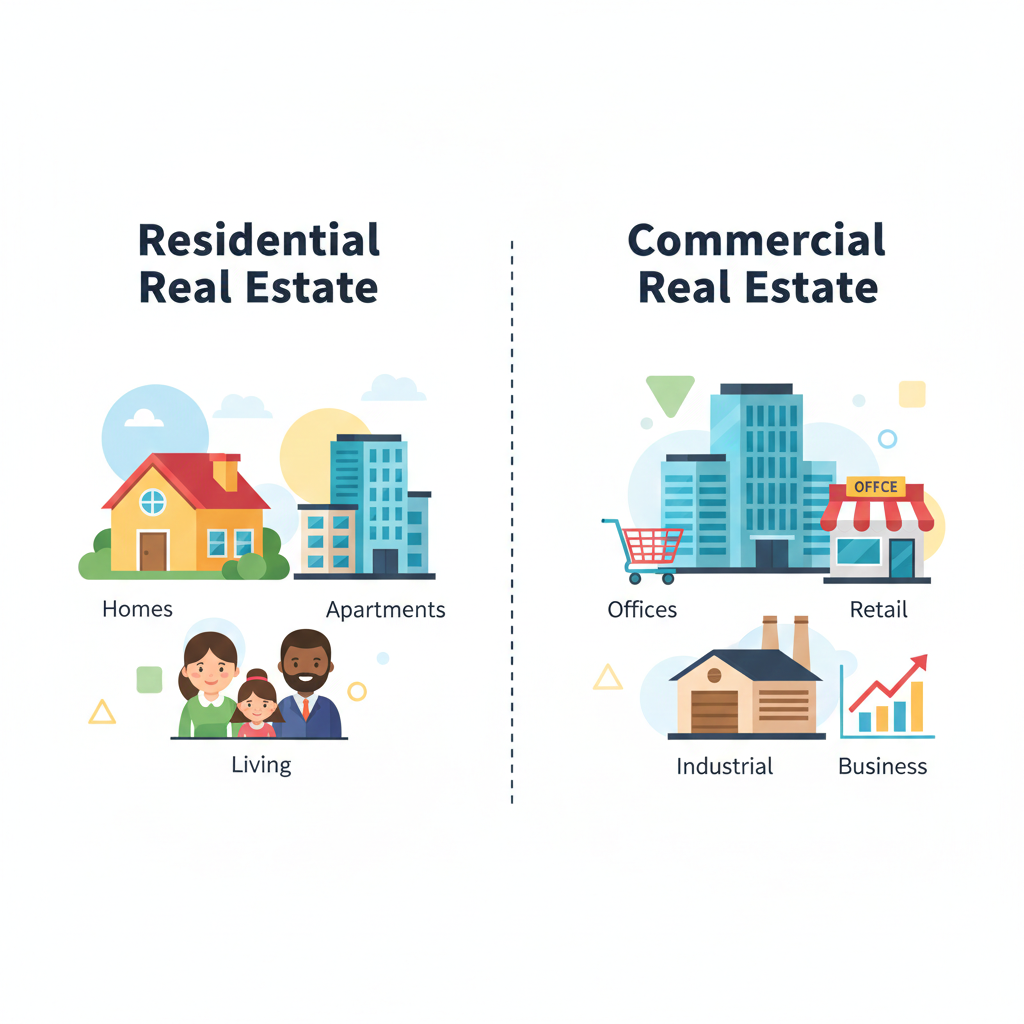
When people talk about real estate, they are usually talking about property. But not all property is the same. Real estate is divided into different types. Two of the most common types are residential real estate and commercial real estate.
If you are new to real estate, it is important to understand the difference. In this guide, we will explain both in very simple words.
What Is Residential Real Estate?
Residential real estate includes properties where people live.
This includes:
- Single-family houses
- Apartments
- Condos
- Townhouses
- Duplexes and small multi-family homes
If a property is mainly used as a place to live, it is residential.
Most first-time buyers and beginners start with residential real estate.
What Is Commercial Real Estate?
Commercial real estate includes properties used for business.
This includes:
- Office buildings
- Shopping centers
- Retail stores
- Warehouses
- Hotels
- Large apartment buildings (usually 5 units or more)
If a property is used to make money through business activity, it is usually commercial.
Main Difference Between Residential and Commercial
The biggest difference is how the property is used.
- Residential = People live there
- Commercial = Businesses operate there
This difference affects:
- Loan rules
- Risk levels
- Income potential
- Management style
Who Buys Residential Real Estate?
Residential properties are often bought by:
- Families
- First-time home buyers
- Small investors
- Landlords
Many people buy residential property to:
- Live in it
- Rent it out
- Build long-term wealth
It is usually easier to understand and manage.
Who Buys Commercial Real Estate?
Commercial properties are usually bought by:
- Experienced investors
- Real estate companies
- Business owners
- Investment groups
Commercial real estate often requires:
- More money
- More experience
- More risk tolerance
It is less common for beginners.
Financing Differences
Loans for residential and commercial properties are very different.
Residential Loans
Residential loans are:
- Easier to qualify for
- Based on personal income and credit score
- Often 15 or 30 years long
- Lower interest rates
These loans are designed for regular buyers.
Commercial Loans
Commercial loans:
- Are based on the property’s income
- Have shorter terms (often 5–20 years)
- May have higher interest rates
- Require larger down payments
Banks look closely at how much money the property earns.
Down Payment Differences
Residential properties often require:
- 3% to 20% down payment
Commercial properties often require:
- 20% to 30% down payment
- Sometimes even more
This makes commercial real estate harder to enter.
Income Potential
Commercial real estate can produce higher income.
For example:
- A shopping center may have many tenants
- A large office building may bring steady rent
But higher income usually comes with higher risk.
Residential properties usually produce:
- Lower rent per unit
- More stable demand
People always need a place to live.
Risk Levels
Residential real estate is usually less risky.
Why?
- Housing is always needed
- Easier to find tenants
- Smaller loan amounts
Commercial real estate can be more risky because:
- Businesses may close
- Economic changes affect demand
- Vacancy periods can be long
A vacant retail space can sit empty for months.
Lease Length
Lease agreements are different too.
Residential Leases
- Usually 6 to 12 months
- Easier to replace tenants
- More frequent tenant turnover
Commercial Leases
- Often 3 to 10 years
- More stable income if tenant stays
- Harder to replace large tenants
Long leases can be good, but if a business fails, it can hurt income.
Property Management Differences
Residential property management:
- Handles tenant repairs
- Collects rent monthly
- Deals with small issues
Commercial property management:
- Handles larger systems
- Negotiates complex leases
- Manages multiple business tenants
Commercial properties require more planning and knowledge.
Maintenance and Repairs
Residential maintenance includes:
- Plumbing
- Roofing
- Appliances
- Basic repairs
Commercial maintenance may include:
- Elevators
- Large HVAC systems
- Parking lots
- Safety systems
Commercial repairs can be expensive.
Market Sensitivity
Residential real estate is often more stable during economic downturns.
People still need homes, even during tough times.
Commercial real estate depends heavily on:
- Business activity
- Consumer spending
- Economic growth
If businesses struggle, commercial spaces may become vacant.
Which Is Better for Beginners?
For most beginners, residential real estate is better.
Reasons:
- Lower entry cost
- Easier loans
- Simpler management
- Lower risk
- Strong demand
Commercial real estate can offer larger returns, but it is more complex.
Long-Term Wealth Building
Both residential and commercial real estate can build wealth.
Residential builds wealth through:
- Steady rental income
- Property appreciation
- Loan paydown over time
Commercial builds wealth through:
- Larger income streams
- Long-term leases
- Business-based growth
The right choice depends on your goals and experience.
Can You Start Residential and Move to Commercial?
Yes.
Many investors:
- Start with a single-family home
- Buy small rental properties
- Gain experience
- Move into commercial later
This is a common and safer path.
Key Points to Remember
- Residential = homes for living
- Commercial = properties for business
- Residential is easier for beginners
- Commercial requires more money and experience
- Risk and reward are usually higher in commercial real estate
Understanding these basics helps you make smarter decisions.
Final Thoughts
Residential and commercial real estate both play important roles in the property market. If you are new to real estate, starting with residential property is usually the simpler and safer option. As you gain knowledge and confidence, you can explore more advanced opportunities.
Call to Action
If you are just starting your real estate journey, explore more beginner-friendly guides on EasyPropertyGuide to build your knowledge step by step and make informed decisions.