
Real estate is one of the most popular ways to build wealth.
Many people buy houses, apartments, or land and hope the value goes up. Some people rent out property and earn monthly income.
But what if you do not have enough money to buy property?
What if you do not want to deal with tenants, repairs, or big loans?
This is where REITs come in.
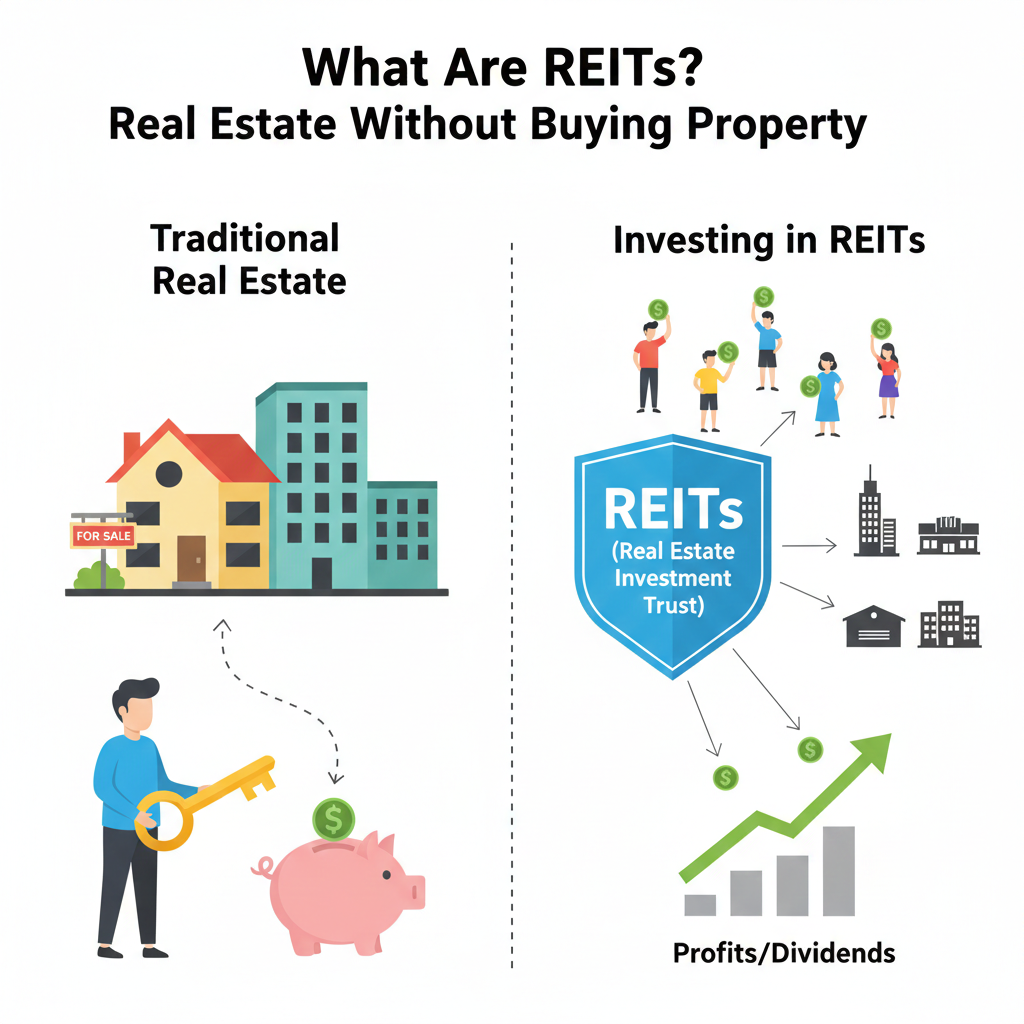
REITs let you invest in real estate without buying property yourself.
Let’s understand this in very simple words.
What Does REIT Mean?
REIT stands for Real Estate Investment Trust.
A REIT is a company that owns real estate.
Instead of buying a house yourself, you can buy shares in this company.
When you buy shares of a REIT, you own a small part of the properties it owns.
It works a lot like buying stocks in the stock market.
How Do REITs Work?
Here is the simple idea.
- A REIT company collects money from many investors.
- It uses that money to buy income-producing real estate.
- The properties earn rent.
- The REIT pays most of that income back to investors as dividends.
So instead of collecting rent from tenants yourself, the REIT does it for you.
You just receive your share of the profits.
What Type of Properties Do REITs Own?
REITs can own many types of real estate.
Here are common examples:
- Apartment buildings
- Office buildings
- Shopping malls
- Hospitals
- Warehouses
- Hotels
- Self-storage facilities
- Data centers
Some REITs focus on only one type of property. Others own many types.
For example, one REIT might only own apartment buildings. Another may focus only on warehouses.
Why Do REITs Pay Dividends?
By law in the United States, most REITs must pay out at least 90% of their taxable income to shareholders as dividends.
This is why REITs are popular with people who want income.
When the properties earn rent, investors receive regular dividend payments.
This makes REITs attractive for retirees and long-term investors.
Types of REITs
There are three main types of REITs.
1. Equity REITs
These are the most common.
They own and operate income-producing properties.
They make money mainly from rent.
Example: A company that owns apartment buildings and collects rent from tenants.
2. Mortgage REITs (mREITs)
These do not own buildings.
Instead, they invest in mortgages or real estate loans.
They earn money from interest payments.
These can be more risky because they depend on interest rates.
3. Hybrid REITs
These are a mix of both equity and mortgage REITs.
They earn money from rent and interest.
How Can You Invest in REITs?
Investing in REITs is easy.
Most REITs are traded on major stock exchanges like normal stocks.
You can buy them using:
- A brokerage account
- A retirement account like an IRA
- Investment apps
You simply search for the REIT’s ticker symbol and buy shares.
You do not need hundreds of thousands of dollars.
You can start with the price of one share.
Benefits of Investing in REITs
Let’s look at why many people like REITs.
1. Lower Cost to Start
Buying a property may require a large down payment.
REITs allow you to invest with much less money.
2. Passive Income
You do not manage tenants.
You do not fix broken pipes.
You do not deal with late rent.
The company handles everything.
You just receive dividends.
3. Diversification
If you buy one house, your money is tied to that one property.
If that area has problems, your investment suffers.
But a REIT may own hundreds of properties in different cities.
This spreads out the risk.
4. Easy to Buy and Sell
Selling a house can take months.
Selling a REIT share takes seconds during market hours.
You can buy or sell quickly.
5. Professional Management
REITs are managed by real estate professionals.
They handle property selection, maintenance, and leasing.
This reduces the work for investors.
Risks of REITs
REITs are not risk-free.
It is important to understand the risks.
1. Market Risk
Since many REITs trade like stocks, their prices can go up and down daily.
Even if properties are doing well, stock prices may fall in a bad market.
2. Interest Rate Risk
When interest rates rise, REIT prices sometimes fall.
Higher rates make borrowing more expensive.
They can also make bonds more attractive compared to REIT dividends.
3. Economic Risk
If the economy is weak, businesses may close.
People may move out of apartments.
This can reduce rental income.
REITs vs Buying Property
Let’s compare both in simple terms.
Buying Property
- Requires large upfront money
- You manage tenants and repairs
- Can use loans to increase returns
- Less liquid (harder to sell quickly)
Investing in REITs
- Lower starting money
- No property management
- Easy to buy and sell
- Income through dividends
Both options can build wealth.
It depends on your goals, money, and time.
Are REITs Good for Beginners?
REITs can be a good starting point for beginners.
They allow you to invest in real estate without:
- Taking large loans
- Handling tenants
- Managing property
They are simple to buy through a brokerage account.
However, like all investments, you should understand the risks.
It is smart to invest for the long term and avoid emotional decisions.
Can REITs Help Build Long-Term Wealth?
Yes, they can.
Over time, REITs can provide:
- Regular dividend income
- Potential growth in share price
When dividends are reinvested, returns can grow faster due to compounding.
Many long-term investors include REITs in their portfolios for income and diversification.
Final Thoughts
REITs make real estate investing simple.
Instead of buying a building, you buy shares in a company that owns buildings.
You earn money through dividends when the properties earn rent.
They offer lower entry costs, professional management, and easy buying and selling.
But they also carry risks, like stock market ups and downs.
If you want exposure to real estate without owning physical property, REITs are one option to consider.
Understanding how they work is the first step toward making smarter investment decisions.